Other
Biographies
Born a prince of Macedonia in 356 BCE, Alexander the Great became one of the greatest military leaders of all time. He conquered the entire Persian Empire, defeating King Darius III four times. He invaded India, defeating a seven-foot-tall Indian king and extending the boundaries of his empire into most of Asia. Brutal in his drive for power, Alexander maintained supremacy by forcing his soldiers to marry the foreigners that they conquered. He amassed a huge fortune by plundering the riches of his enemies and married two foreign princesses, one of them King Darius III's daughter. By the time of his death at age thirty-two, Alexander had conquered most of the known ancient Greek world, a remarkable achievement in only twelve years. Demi's storytelling skills bring Alexander the Great's exploits to life. Her splendid illustrations were painted with Chinese inks and gold overlays and with frames inspired by jewels from the tomb of Philip II of Macedonia at Verghina. An author's note describing Demi's research and source material is included.

Steve Jobs was a visionary entrepreneur who contributed immeasurably to information technology, changing not only the way we do business but also the way we communicate and share information. His company, Apple, founded in 1976 with Steve Wozniak, eventually launched the Macintosh computer in 1984, with a graphical user interface that competed with the early versions of Microsoft Windows.
This reference biography sheds light on Jobs's departure from Apple in 1985, his extraordinary comeback in 1997, and his innovations in the meantime, which included the founding of the computer animation company Pixar. Jobs and Apple went on to launch the iPod, iTunes, the iPhone, and the iPad. Author Michael Becraft has distilled the vast literature on Jobs into a concise but vivid portrait of the man, his vision, the controversies that have swirled around him, and his lasting impact on business, culture, and society.
Arranged chronologically, the book includes extensive primary sources and is written to be accessible to a wide range of readers. Additionally, it incorporates images that heighten reader engagement, provides a timeline for referencing Jobs's achievements across his lifetime, and supplies an extensive bibliography for those seeking original source documents.
A New York Times Bestseller
In the spirit of Steve Jobs and Moneyball, Elon Musk is both an illuminating and authorized look at the extraordinary life of one of Silicon Valley’s most exciting, unpredictable, and ambitious entrepreneurs—a real-life Tony Stark—and a fascinating exploration of the renewal of American invention and its new “makers.”
Elon Musk spotlights the technology and vision of Elon Musk, the renowned entrepreneur and innovator behind SpaceX, Tesla, and SolarCity, who sold one of his Internet companies, PayPal, for $1.5 billion. Ashlee Vance captures the full spectacle and arc of the genius’s life and work, from his tumultuous upbringing in South Africa and flight to the United States to his dramatic technical innovations and entrepreneurial pursuits.
Vance uses Musk’s story to explore one of the pressing questions of our age: can the nation of inventors and creators who led the modern world for a century still compete in an age of fierce global competition? He argues that Musk—one of the most unusual and striking figures in American business history—is a contemporary, visionary amalgam of legendary inventors and industrialists including Thomas Edison, Henry Ford, Howard Hughes, and Steve Jobs. More than any other entrepreneur today, Musk has dedicated his energies and his own vast fortune to inventing a future that is as rich and far-reaching as the visionaries of the golden age of science-fiction fantasy.
Thorough and insightful, Elon Musk brings to life a technology industry that is rapidly and dramatically changing by examining the life of one of its most powerful and influential titans.

A SUNDAY TIMES, THE TIMES, ECONOMIST, DAILY TELEGRAPH, EVENING STANDARD, OBSERVER BOOK OF THE YEAR
'Undoubtedly the best single-volume life of Churchill ever written' Dominic Sandbrook, Sunday Times
A magnificently fresh and unexpected biography of Churchill, by one of Britain's most acclaimed historians
Winston Churchill towers over every other figure in twentieth-century British history. By the time of his death at the age of 90 in 1965, many thought him to be the greatest man in the world.
There have been over a thousand previous biographies of Churchill. Andrew Roberts now draws on over forty new sources, including the private diaries of King George VI, used in no previous Churchill biography to depict him more intimately and persuasively than any of its predecessors. The book in no way conceals Churchill's faults and it allows the reader to appreciate his virtues and character in full: his titanic capacity for work (and drink), his ability see the big picture, his willingness to take risks and insistence on being where the action was, his good humour even in the most desperate circumstances, the breadth and strength of his friendships and his extraordinary propensity to burst into tears at unexpected moments. Above all, it shows us the wellsprings of his personality - his lifelong desire to please his father (even long after his father's death) but aristocratic disdain for the opinions of almost everyone else, his love of the British Empire, his sense of history and its connection to the present.
During the Second World War, Churchill summoned a particular scientist to see him several times for technical advice. 'It was the same whenever we met', wrote the young man, 'I had a feeling of being recharged by a source of living power.' Harry Hopkins, President Roosevelt's emissary, wrote 'Wherever he was, there was a battlefront.' Field Marshal Sir Alan Brooke, Churchill's essential partner in strategy and most severe critic in private, wrote in his diary, 'I thank God I was given such an opportunity of working alongside such a man, and of having my eyes opened to the fact that occasionally such supermen exist on this earth.'
Based on thousands of pages from Leonardo’s astonishing notebooks and new discoveries about his life and work, Walter Isaacson weaves a narrative that connects his art to his science. He shows how Leonardo’s genius was based on skills we can improve in ourselves, such as passionate curiosity, careful observation, and an imagination so playful that it flirted with fantasy.
He produced the two most famous paintings in history, The Last Supper and the Mona Lisa. But in his own mind, he was just as much a man of science and technology. With a passion that sometimes became obsessive, he pursued innovative studies of anatomy, fossils, birds, the heart, flying machines, botany, geology, and weaponry. His ability to stand at the crossroads of the humanities and the sciences, made iconic by his drawing of Vitruvian Man, made him history’s most creative genius.
His creativity, like that of other great innovators, came from having wide-ranging passions. He peeled flesh off the faces of cadavers, drew the muscles that move the lips, and then painted history’s most memorable smile. He explored the math of optics, showed how light rays strike the cornea, and produced illusions of changing perspectives in The Last Supper. Isaacson also describes how Leonardo’s lifelong enthusiasm for staging theatrical productions informed his paintings and inventions.
Leonardo’s delight at combining diverse passions remains the ultimate recipe for creativity. So, too, does his ease at being a bit of a misfit: illegitimate, gay, vegetarian, left-handed, easily distracted, and at times heretical. His life should remind us of the importance of instilling, both in ourselves and our children, not just received knowledge but a willingness to question it—to be imaginative and, like talented misfits and rebels in any era, to think different.
In Jeff Bezos's own words, the core principles and philosophy that have guided him in creating, building, and leading Amazon and Blue Origin.
In this collection of Jeff Bezos's writings—his unique and strikingly original annual shareholder letters, plus numerous speeches and interviews that provide insight into his background, his work, and the evolution of his ideas—you'll gain an insider's view of the why and how of his success. Spanning a range of topics across business and public policy, from innovation and customer obsession to climate change and outer space, this book provides a rare glimpse into how Bezos thinks about the world and where the future might take us.
Written in a direct, down-to-earth style, Invent and Wander offers readers a master class in business values, strategy, and execution:
- The importance of a Day 1 mindset
- Why "it's all about the long term"
- What it really means to be customer obsessed
- How to start new businesses and create significant organic growth in an already successful company
- Why culture is an imperative
- How a willingness to fail is closely connected to innovation
- What the Covid-19 pandemic has taught us
Each insight offers new ways of thinking through today's challenges—and more importantly, tomorrow's—and the never-ending urgency of striving ahead, never resting on one's laurels. Everyone from CEOs of the Fortune 100 to entrepreneurs just setting up shop to the millions who use Amazon's products and services in their homes or businesses will come to understand the principles that have driven the success of one of the most important innovators of our time.
Invent and Wander: The Collected Writings of Jeff Bezos is co-published by PublicAffairs, an imprint of Perseus Books, and Harvard Business Review Press.
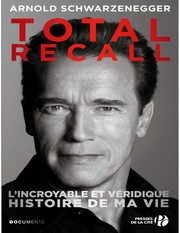
The greatest immigrant success story of our time. Arnold Schwarzenegger’s story is unique—and uniquely entertaining—and he tells it brilliantly in these pages.
He was born in a year of famine in a small Austrian town, the son of an austere police chief. He dreamed of moving to America to become a bodybuilding champion and a movie star. By the age of twenty-one, he was living in Los Angeles and had been crowned Mr. Universe. Within five years, he had learned English and become the greatest bodybuilder in the world. Within ten years, he had earned his college degree and was a millionaire from his business enterprises in real estate, landscaping, and bodybuilding. He was also the winner of a Golden Globe Award for his debut as a dramatic actor in Stay Hungry. Within twenty years, he was the world’s biggest movie star, the husband of Maria Shriver, and an emerging Republican leader who was part of the Kennedy family. Thirty-six years after coming to America, the man once known by fellow bodybuilders as the Austrian Oak was elected governor of California.
Now, with raw honesty and insight, he tells the story of his life in his own voice. Here is Arnold, with total recall.
This inspiring, exquisitely observed memoir finds hope and beauty in the face of insurmountable odds as an idealistic young neurosurgeon attempts to answer the question, What makes a life worth living?
“Unmissable . . . Finishing this book and then forgetting about it is simply not an option.”—Janet Maslin, The New York Times
ONE OF THE BEST BOOKS OF THE YEAR: The New York Times Book Review, People, NPR, The Washington Post, Slate, Harper’s Bazaar, Time Out New York, Publishers Weekly, BookPage
An Oprah Daily Best Nonfiction Book of the Past Two Decades • A Kirkus Reviews Best Nonfiction Book of the Century
At the age of thirty-six, on the verge of completing a decade’s worth of training as a neurosurgeon, Paul Kalanithi was diagnosed with stage IV lung cancer. One day he was a doctor treating the dying, and the next he was a patient struggling to live. And just like that, the future he and his wife had imagined evaporated. When Breath Becomes Air chronicles Kalanithi’s transformation from a naïve medical student “possessed,” as he wrote, “by the question of what, given that all organisms die, makes a virtuous and meaningful life” into a neurosurgeon at Stanford working in the brain, the most critical place for human identity, and finally into a patient and new father confronting his own mortality.
What makes life worth living in the face of death? What do you do when the future, no longer a ladder toward your goals in life, flattens out into a perpetual present? What does it mean to have a child, to nurture a new life as another fades away? These are some of the questions Kalanithi wrestles with in this profoundly moving, exquisitely observed memoir.
Paul Kalanithi died in March 2015, while working on this book, yet his words live on as a guide and a gift to us all. “I began to realize that coming face to face with my own mortality, in a sense, had changed nothing and everything,” he wrote. “Seven words from Samuel Beckett began to repeat in my head: ‘I can’t go on. I’ll go on.’” When Breath Becomes Air is an unforgettable, life-affirming reflection on the challenge of facing death and on the relationship between doctor and patient, from a brilliant writer who became both.
Finalist for the PEN Center USA Literary Award in Creative Nonfiction and the Books for a Better Life Award in Inspirational Memoir
Book Club
Named one of the best books of the year by The Wall Street Journal, The New York Times Book Review, The Washington Post, Time, The Economist, New York Post, and Town & Country • One of Barack Obama’s Favorite Books of the Year • Named finalist for the PEN Literary Awards
“With tenacity and candor, Haidt lays out the consequences that have come with allowing kids to drift further into the virtual world . . . While also offering suggestions and solutions that could help protect a new generation of kids.” —Time
After more than a decade of stability or improvement, the mental health of adolescents plunged in the early 2010s. Rates of depression, anxiety, self-harm, and suicide rose sharply, more than doubling on many measures. Why?
In The Anxious Generation, social psychologist Jonathan Haidt (pronounced "height") lays out the facts about the epidemic of teen mental illness that hit many countries at the same time. He then investigates the nature of childhood, including why children need play and independent exploration to mature into competent, thriving adults. Haidt shows how the “play-based childhood” began to decline in the 1980s, and how it was finally wiped out by the arrival of the “phone-based childhood” in the early 2010s. He presents more than a dozen mechanisms by which this “great rewiring of childhood” has interfered with children’s social and neurological development, covering everything from sleep deprivation to attention fragmentation, addiction, loneliness, social contagion, social comparison, and perfectionism. He explains why social media damages girls more than boys and why boys have been withdrawing from the real world into the virtual world, with disastrous consequences for themselves, their families, and their societies.
Most important, Haidt issues a clear call to action. He diagnoses the “collective action problems” that trap us, and then proposes four simple rules that might set us free. He describes steps that parents, teachers, schools, tech companies, and governments can take to end the epidemic of mental illness and restore a more humane childhood.
Haidt has spent his career speaking truth backed by data in the most difficult landscapes—communities polarized by politics and religion, campuses battling culture wars, and now the public health emergency faced by Gen Z. We cannot afford to ignore his findings about protecting our children—and ourselves—from the psychological damage of a phone-based life.
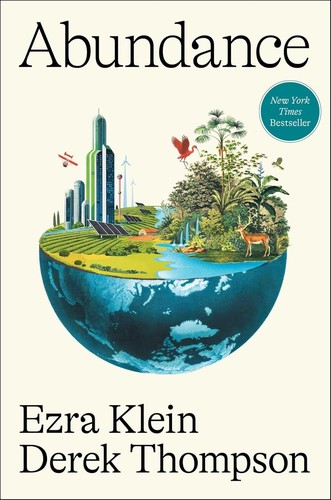
“A must-read for progressives who want a blueprint for reforming government so it can deliver for working people.” —Barack Obama • “A terrific book...Powerful and persuasive.” —Fareed Zakaria • “Spectacular…Offers a comprehensive indictment of the current problems and a clear path forward…Klein and Thompson usher in a mood shift. They inspire hope and enlarge the imagination.” —David Brooks, The New York Times
From bestselling authors and journalistic titans Ezra Klein and Derek Thompson, Abundance is a once-in-a-generation, paradigm-shifting call to renew a politics of plenty, face up to the failures of liberal governance, and abandon the chosen scarcities that have deformed American life.
To trace the history of the twenty-first century so far is to trace a history of unaffordability and shortage. After years of refusing to build sufficient housing, America has a national housing crisis. After years of limiting immigration, we don’t have enough workers. Despite decades of being warned about the consequences of climate change, we haven’t built anything close to the clean-energy infrastructure we need. Ambitious public projects are finished late and over budget—if they are ever finished at all. The crisis that’s clicking into focus now has been building for decades—because we haven’t been building enough.
Abundance explains that our problems today are not the results of yesteryear’s villains. Rather, one generation’s solutions have become the next generation’s problems. Rules and regulations designed to solve the problems of the 1970s often prevent urban-density and green-energy projects that would help solve the problems of the 2020s. Laws meant to ensure that government considers the consequences of its actions have made it too difficult for government to act consequentially. In the last few decades, our capacity to see problems has sharpened while our ability to solve them has diminished.
Progress requires facing up to the institutions in life that are not working as they need to. It means, for liberals, recognizing when the government is failing. It means, for conservatives, recognizing when the government is needed. In a book exploring how we can move from a liberalism that not only protects and preserves but also builds, Klein and Thompson trace the political, economic, and cultural barriers to progress and propose a path toward a politics of abundance. At a time when movements of scarcity are gaining power in country after country, this is an answer that meets the challenges of the moment while grappling honestly with the fury so many rightfully feel.
#1 New York Times Bestseller
In Being Mortal, bestselling author Atul Gawande tackles the hardest challenge of his profession: how medicine can not only improve life but also the process of its ending
Medicine has triumphed in modern times, transforming birth, injury, and infectious disease from harrowing to manageable. But in the inevitable condition of aging and death, the goals of medicine seem too frequently to run counter to the interest of the human spirit. Nursing homes, preoccupied with safety, pin patients into railed beds and wheelchairs. Hospitals isolate the dying, checking for vital signs long after the goals of cure have become moot. Doctors, committed to extending life, continue to carry out devastating procedures that in the end extend suffering.
Gawande, a practicing surgeon, addresses his profession's ultimate limitation, arguing that quality of life is the desired goal for patients and families. Gawande offers examples of freer, more socially fulfilling models for assisting the infirm and dependent elderly, and he explores the varieties of hospice care to demonstrate that a person's last weeks or months may be rich and dignified.
Full of eye-opening research and riveting storytelling, Being Mortal asserts that medicine can comfort and enhance our experience even to the end, providing not only a good life but also a good end.
"Concise and elegant. . . . Rauch applies careful research and incisive prose to examine, diagnose, and prescribe a cure for the maladies afflicting contemporary religious-political dynamics."--Michael M. Rosen, Commentary
What happens to American democracy if Christianity is no longer able, or no longer willing, to perform the functions on which our constitutional order depends? In this provocative book, the award-winning journalist Jonathan Rauch--a lifelong atheist--reckons candidly with both the shortcomings of secularism and the corrosion of Christianity.
Thin Christianity, as Rauch calls the mainline church, has been unable to inspire and retain believers. Worse, a Church of Fear has distorted white evangelicalism in ways that violate the tenets of both Jesus and James Madison. What to do? For answers, Rauch looks to a new generation of religious thinkers, as well as to the Church of Jesus Christ of Latter-day Saints, which has placed the Constitution at the heart of its spiritual teachings.
In this timely critique Rauch addresses secular Americans who think Christianity can be abandoned, and Christian Americans who blame secular culture for their grievances. The two must work together, he argues, to confront our present crisis. He calls on Christians to recommit to the teachings of their faith that align with Madison, not MAGA, and to understand that liberal democracy, far from being oppressive, is uniquely protective of religious freedom. At the same time, he calls on secular liberals to understand that healthy religious institutions are crucial to the survival of the liberal state.

'Ground-breaking. Everyone should read this book' Bessel van der Kolk, author of The Body Keeps the Score
When it comes to understanding the connection between our mental and physical health, we should be looking at the exceptions, not the rules.
Dr Jeff Rediger, a world-leading Harvard psychiatrist, has spent the last fifteen years studying thousands of individuals from around the world, examining the stories behind extraordinary cases of recovery from terminal illness.
Observing the common denominators of people who have beaten the odds, Dr Rediger reveals the immense power of our immune system and unlocks the secrets of the mind-body connection. In Cured, he explains the vital role that nutrition plays in boosting our immunity and fighting off disease, and he also outlines how stress, trauma and identity affect our physical health.
In analysing the remarkable science of recovery, Dr Rediger reveals the power of our mind to heal our body and shows us the keys to good health.
'In an era of incurable chronic diseases causing 60% of all deaths worldwide, this book provides one potential way out' Dr Mark Hyman, author of The Blood Sugar Solution
'Seasoned with the author's penetrating insights about healing, clearly articulated science and illuminating case histories, Cured opens genuine vistas of transforming illness into health' Gabor Maté, author of When the Body Says No
“What an incredibly thorough documentation of the causes of the immigration crisis, the discussions that have been going on through multiple administrations.” —Jon Stewart, The Daily Show
“Everyone Who Is Gone Is Here is sure to take its place as one of the definitive accounts of the U.S. and Central American immigration puzzle. . . . Hopefully, those with the power to change things will listen.” —Manuel Roig-Franzia, Washington Post
An epic, heartbreaking, and deeply reported history of the disastrous humanitarian crisis at the southern border told through the lives of the migrants forced to risk everything and the policymakers who determine their fate, by New Yorker staff writer Jonathan Blitzer
Everyone who makes the journey faces an impossible choice. Hundreds of thousands of people who arrive every year at the US-Mexico border travel far from their homes. For years, the majority came from El Salvador, Guatemala, and Honduras, but many more have begun their journey much farther away. Some flee persecution, others crime or hunger. They may have already been deported, but the United States remains their only hope for safety and prosperity. They will take their chances.
As Jonathan Blitzer dramatizes with forensic, unprecedented reporting, this crisis is the result of decades of misguided policy and sweeping corruption. Brilliantly weaving the stories of Central Americans whose lives have been devastated by chronic political conflict and violence with those of American activists, government officials, and the politicians responsible for the country’s tragically tangled immigration policy, Blitzer reveals the full, layered picture of this vast and unremitting conflict.
Everyone Who Is Gone Is Here tells the epic story of the people whose lives ebb and flow across the border, delving into the heart of American life itself. This vital and remarkable story has shaped the nation’s turbulent politics and culture in countless ways—and will almost certainly determine its future.

Why is Miami…Miami? What does the heartbreaking fate of the cheetah tell us about the way we raise our children? Why do Ivy League schools care so much about sports? What is the Magic Third, and what does it mean for racial harmony? In this provocative new work, Malcolm Gladwell returns for the first time in twenty-five years to the subject of social epidemics and tipping points, this time with the aim of explaining the dark side of contagious phenomena.
Through a series of riveting stories, Gladwell traces the rise of a new and troubling form of social engineering. He takes us to the streets of Los Angeles to meet the world’s most successful bank robbers, rediscovers a forgotten television show from the 1970s that changed the world, visits the site of a historic experiment on a tiny cul-de-sac in northern California, and offers an alternate history of two of the biggest epidemics of our day: COVID and the opioid crisis. Revenge of the Tipping Point is Gladwell’s most personal book yet. With his characteristic mix of storytelling and social science, he offers a guide to making sense of the contagions of modern world. It’s time we took tipping points seriously.
Most Anticipated in:
AARP| Associated Press| Time Magazine | Oprah Daily | Chicago Tribune | Literary Hub |
Publishers Weekly | Publishers Lunch
“Expert storytelling . . . [Pollan] masterfully elevates a series of big questions about drugs, plants and humans that are likely to leave readers thinking in new ways.” —New York Times Book Review
From #1 New York Times bestselling author Michael Pollan, a radical challenge to how we think about drugs, and an exploration into the powerful human attraction to psychoactive plants—and the equally powerful taboos.
Of all the things humans rely on plants for—sustenance, beauty, medicine, fragrance, flavor, fiber—surely the most curious is our use of them to change consciousness: to stimulate or calm, fiddle with or completely alter, the qualities of our mental experience. Take coffee and tea: People around the world rely on caffeine to sharpen their minds. But we do not usually think of caffeine as a drug, or our daily use as an addiction, because it is legal and socially acceptable. So, then, what is a “drug”? And why, for example, is making tea from the leaves of a tea plant acceptable, but making tea from a seed head of an opium poppy a federal crime?
In This Is Your Mind on Plants, Michael Pollan dives deep into three plant drugs—opium, caffeine, and mescaline—and throws the fundamental strangeness, and arbitrariness, of our thinking about them into sharp relief. Exploring and participating in the cultures that have grown up around these drugs while consuming (or, in the case of caffeine, trying not to consume) them, Pollan reckons with the powerful human attraction to psychoactive plants. Why do we go to such great lengths to seek these shifts in consciousness, and then why do we fence that universal desire with laws and customs and fraught feelings?
In this unique blend of history, science, and memoir, as well as participatory journalism, Pollan examines and experiences these plants from several very different angles and contexts, and shines a fresh light on a subject that is all too often treated reductively—as a drug, whether licit or illicit. But that is one of the least interesting things you can say about these plants, Pollan shows, for when we take them into our bodies and let them change our minds, we are engaging with nature in one of the most profound ways we can. Based in part on an essay published almost twenty-five years ago, this groundbreaking and singular consideration of psychoactive plants, and our attraction to them through time, holds up a mirror to our fundamental human needs and aspirations, the operations of our minds, and our entanglement with the natural world.
“O’Neil reminds us that we must resist the urge to judge, belittle, and oversimplify, and instead allow always for complexity and lead always with empathy.”—Dave Eggers, author of The Every
ONE OF THE BEST BOOKS OF THE YEAR: The Times (UK)
Shame is a powerful and sometimes useful tool: When we publicly shame corrupt politicians, abusive celebrities, or predatory corporations, we reinforce values of fairness and justice. But as Cathy O’Neil argues in this revelatory book, shaming has taken a new and dangerous turn. It is increasingly being weaponized—used as a way to shift responsibility for social problems from institutions to individuals. Shaming children for not being able to afford school lunches or adults for not being able to find work lets us off the hook as a society. After all, why pay higher taxes to fund programs for people who are fundamentally unworthy?
O’Neil explores the machinery behind all this shame, showing how governments, corporations, and the healthcare system capitalize on it. There are damning stories of rehab clinics, reentry programs, drug and diet companies, and social media platforms—all of which profit from “punching down” on the vulnerable. Woven throughout The Shame Machine is the story of O’Neil’s own struggle with body image and her recent weight-loss surgery, which awakened her to the systematic shaming of fat people seeking medical care.
With clarity and nuance, O’Neil dissects the relationship between shame and power. Whom does the system serve? Is it counter-productive to call out racists, misogynists, and vaccine skeptics? If so, when should someone be “canceled”? How do current incentive structures perpetuate the shaming cycle? And, most important, how can we all fight back?
China
Dr. Kai-Fu Lee--one of the world's most respected experts on AI and China--reveals that China has suddenly caught up to the US at an astonishingly rapid and unexpected pace.
In AI Superpowers, Kai-fu Lee argues powerfully that because of these unprecedented developments in AI, dramatic changes will be happening much sooner than many of us expected. Indeed, as the US-Sino AI competition begins to heat up, Lee urges the US and China to both accept and to embrace the great responsibilities that come with significant technological power. Most experts already say that AI will have a devastating impact on blue-collar jobs. But Lee predicts that Chinese and American AI will have a strong impact on white-collar jobs as well. Is universal basic income the solution? In Lee's opinion, probably not. But he provides a clear description of which jobs will be affected and how soon, which jobs can be enhanced with AI, and most importantly, how we can provide solutions to some of the most profound changes in human history that are coming soon.
Israel
Winner of the Los Angeles Times Book Prize in History and one of the New York Times’s 100 Notable Books of the Year.
The assassination of Israeli Prime Minister Yitzhak Rabin remains the single most consequential event in Israel’s recent history, and one that fundamentally altered the trajectory for both Israel and the Palestinians. In Killing a King, Dan Ephron relates the parallel stories of Rabin and his stalker, Yigal Amir, over the two years leading up to the assassination, as one of them planned political deals he hoped would lead to peace, and the other plotted murder. "Carefully reported, clearly presented, concise and gripping," It stands as "a reminder that what happened on a Tel Aviv sidewalk 20 years ago is as important to understanding Israel as any of its wars" (Matti Friedman, The Washington Post).
Why do Israelis have among the world’s highest life expectancies and lowest rates of “deaths of despair” from suicide and substance abuse? Why is Israel’s population young and growing while all other wealthy democracies are aging and shrinking? How can it be that Israel, according to a United Nations ranking, is the fourth happiest nation in the world? Why do Israelis tend to look to the future with hope, optimism, and purpose while the rest of the West struggles with an epidemic of loneliness, teen depression, and social decline?
Dan Senor and Saul Singer, the writers behind the international bestseller Start-Up Nation, have long been students of the global innovation race. But as they spent time with Israel’s entrepreneurs and political leaders, soldiers and students, scientists and activists, ultra-Orthodox Jews, Tel Aviv techies, and Israeli Arabs, they realized that they had missed what really sets Israel apart.
Moving from military commanders integrating at-risk youth and people who are neurodiverse into national service, to high performing companies making space for working parents, from dreamers and innovators launching a duct-taped spacecraft to the moon, to bringing better health solutions to people around the world, The Genius of Israel tells the story of a diverse people and society built around the values of service, solidarity, and belonging.
Widely admired for having the world’s highest density of high-tech start-ups, Israel’s greatest innovation may not be a technology at all, but Israeli society itself. Understanding how a country facing so many challenges can be among the happiest provides surprising insights into how we can confront the crisis of community, human connectedness, and purpose in modern life.
Bold, timely, and insightful, Senor and Singer’s latest work shines an important light on the impressive innovative distinctions of Israeli society—and what other communities and countries can learn.
Society

WINNER OF THE PULITZER PRIZE • WINNER OF THE WOMEN'S PRIZE FOR FICTION
New York Times Readers’ Pick: Top 100 Books of the 21st Century • An Oprah’s Book Club Selection • An Instant New York Times Bestseller • An Instant Wall Street Journal Bestseller • A #1 Washington Post Bestseller • A New York Times "Ten Best Books of the Year"
"Demon is a voice for the ages—akin to Huck Finn or Holden Caulfield—only even more resilient.” —Beth Macy, author of Dopesick
"May be the best novel of [the year]. . . . Equal parts hilarious and heartbreaking, this is the story of an irrepressible boy nobody wants, but readers will love.” —Ron Charles, Washington Post
From the acclaimed author of The Poisonwood Bible and The Bean Trees and the recipient of the National Book Foundation's Medal for Distinguished Contribution to American Letters, a brilliant novel that enthralls, compels, and captures the heart as it evokes a young hero’s unforgettable journey to maturity
Set in the mountains of southern Appalachia, Demon Copperhead is the story of a boy born to a teenaged single mother in a single-wide trailer, with no assets beyond his dead father’s good looks and copper-colored hair, a caustic wit, and a fierce talent for survival. Relayed in his own unsparing voice, Demon braves the modern perils of foster care, child labor, derelict schools, athletic success, addiction, disastrous loves, and crushing losses. Through all of it, he reckons with his own invisibility in a popular culture where even the superheroes have abandoned rural people in favor of cities.
Many generations ago, Charles Dickens wrote David Copperfield from his experience as a survivor of institutional poverty and its damages to children in his society. Those problems have yet to be solved in ours. Dickens is not a prerequisite for readers of this novel, but he provided its inspiration. In transposing a Victorian epic novel to the contemporary American South, Barbara Kingsolver enlists Dickens’ anger and compassion, and above all, his faith in the transformative powers of a good story. Demon Copperhead speaks for a new generation of lost boys, and all those born into beautiful, cursed places they can’t imagine leaving behind.
Hillbilly Elegy recounts Vice President J.D. Vance's powerful origin story...
From a former marine and Yale Law School graduate now serving as the Vice President of the United States, an incisive account of growing up in a poor Rust Belt town that offers a broader, probing look at the struggles of America's white working class.
THE #1 NEW YORK TIMES BESTSELLER
"You will not read a more important book about America this year."—The Economist
"A riveting book."—The Wall Street Journal
"Essential reading."—David Brooks, New York Times
This bestselling memoir, Hillbilly Elegy, is a passionate and personal analysis of a culture in crisis—that of white working-class Americans in the Rust Belt. The disintegration of this group, a process that has been slowly occurring now for more than forty years, has been reported with growing frequency and alarm, but has never before been written about as searingly from the inside. J. D. Vance tells the true story of what a social, regional, and class decline feels like, offering a searing inside look at poverty in America.
The Vance family story, a powerful example of the struggle for social mobility, begins hopefully in postwar America. J. D.'s grandparents were "dirt poor and in love," and moved north from Kentucky's Appalachia region to Ohio in the hopes of escaping the dreadful poverty around them. They raised a middle-class family, and eventually one of their grandchildren would graduate from Yale Law School, a conventional marker of success in achieving generational upward mobility. But as the family saga of Hillbilly Elegy plays out, we learn that J.D.'s grandparents, aunt, uncle, and, most of all, his mother struggled profoundly with the demands of their new middle-class life, never fully escaping the legacy of abuse, addiction, poverty, and family trauma so characteristic of their part of America. With piercing honesty, Vance shows how he himself still carries around the demons of his chaotic family history.
A deeply moving story about Appalachian culture, with its share of humor and vividly colorful figures, Hillbilly Elegy is the story of how upward mobility really feels. And it is an urgent and troubling meditation on the loss of the American dream for a large segment of this country.
What does it take to break a cycle of poverty and trauma that spans generations?
- A Raw Look at the White Working Class: Go beyond the headlines for a deeply personal account of a people in crisis, from the hollers of Kentucky to the factory towns of Ohio.
- The Legacy of Addiction and Trauma: Witness the devastating impact of alcoholism and abuse as one family grapples with the demons that followed them from Appalachia.
- An Unlikely Path to the Ivy League: Follow J.D. Vance's improbable journey from a former marine to a Yale Law School graduate, showing what upward mobility truly feels like.
- The Fraying American Dream: An urgent, searingly honest meditation on what happens when the promise of a better life seems to slip away for an entire segment of the country.
“One of the best efforts to give us an integrated vision of where we are going.”—The Wall Street Journal
First comes a High, a period of confident expansion. Next comes an Awakening, a time of spiritual exploration and rebellion. Then comes an Unraveling, in which individualism triumphs over crumbling institutions. Last comes a Crisis—the Fourth Turning—when society passes through a great and perilous gate in history.
William Strauss and Neil Howe will change the way you see the world—and your place in it. With blazing originality, The Fourth Turning illuminates the past, explains the present, and reimagines the future. Most remarkably, it offers an utterly persuasive prophecy about how America’s past will predict what comes next.
Strauss and Howe base this vision on a provocative theory of American history. The authors look back five hundred years and uncover a distinct pattern: Modern history moves in cycles, each one lasting about the length of a long human life, each composed of four twenty-year eras—or “turnings”—that comprise history’s seasonal rhythm of growth, maturation, entropy, and rebirth. Illustrating this cycle through a brilliant analysis of the post–World War II period, The Fourth Turning offers bold predictions about how all of us can prepare, individually and collectively, for this rendezvous with destiny.
Tales of Life
Essential reading for the 50th anniversary of Springsteen’s seminal album Born to Run, the long-awaited release of Nebraska ’82, and a companion to the acclaimed film Deliver Me from Nowhere, starring Jeremy Allen White and Jeremy Strong, about the writing and recording of Springsteen’s classic Nebraska record.
Following his 2009 Super Bowl halftime performance, Bruce Springsteen privately devoted himself to writing the story of his life. The result is “an utterly unique, endlessly exhilarating, last-chance-power-drive of a memoir” (Rolling Stone) that offers the same honesty, humor, and originality found in his songs.
He describes growing up Catholic in Freehold, New Jersey, amid the poetry, danger, and darkness that fueled his imagination, leading up to the moment he refers to as “The Big Bang”: seeing Elvis Presley’s debut on The Ed Sullivan Show. He vividly recounts his relentless drive to become a musician, his early days as a bar band king in Asbury Park, and the rise of the E Street Band. With disarming candor, he also tells for the first time the story of the personal struggles that inspired his best work.
Rarely has a performer told his own story with such force and sweep. Like many of his songs (“Thunder Road,” “Badlands,” “Darkness on the Edge of Town,” “The River” “Born in the USA,” “The Rising,” and “The Ghost of Tom Joad,” to name just a few), Bruce Springsteen’s autobiography is written with the lyricism of a singular songwriter and the wisdom of a man who has thought deeply about his experiences.
“Both an entertaining account of Springsteen’s marathon race to the top and a reminder that the one thing you can’t run away from is yourself” (Entertainment Weekly), Born to Run is much more than a legendary rock star’s memoir. This book is a “a virtuoso performance, the 508-page equivalent to one of Springsteen and the E Street Band’s famous four-hour concerts: Nothing is left onstage, and diehard fans and first-timers alike depart for home sated and yet somehow already aching for more” (NPR).
Winner of 5 national awards, Recipes for a Sacred Life is now available in a new, expanded edition.
"Recipes for a Sacred Life left us moved—and changed. Wise, poignant, funny, and inspiring."—Redbook
ON A DARK WINTER NIGHT with little to do, Rivvy Neshama took a "Find Your Highest Purpose" quiz. And the funny thing was, she found it: to live a sacred life. Problem was, she didn't know how.
But she set out to learn. And in the weeks and months that followed, she began to remember and encounter all the people and experiences featured in this book-from her father's jokes to her mother's prayers, from Billie in Harlem to a stranger in Salzburg, and from warm tortillas to the humble oatmeal. Each became a story, like a recipe passed down, beginning with her mother and her simple toast to life.
NESHAMA'S TRUE TALES, a memoir of sorts, are filled with love, warmth, and timeless wisdom. They ground us, and they lift us up. They make us laugh, and they make us cry. And most of all, they connect us more deeply with the grace and meaning of our lives.
"Exquisite storytelling. Written in the spirit of Elizabeth Gilbert or Anne Lamott, Neshama's stories (and a few miracles) are uplifting, witty, and wise." —Publishers Weekly
"Rivvy's bite-sized stories will make you nod with deepest knowing. It's a magical companion."—HuffPost
"Wouldn't it be wonderful if there was a guide to happiness? Recipes for a Sacred Life is the closest thing I've found. Powerful. Inspiring. About adding love and joy to the everyday."—First for Women magazine
THE NEW YORK TIMES BESTSELLER AND SUNDAY TIMES, OBSERVER AND BBC HISTORY BOOK OF THE YEAR
FINALIST FOR THE ORWELL PRIZE FOR POLITICAL WRITING 2022
'Pacey and potentially revolutionary' Sunday Times
'Iconoclastic and irreverent ... an exhilarating read' The Guardian
For generations, our remote ancestors have been cast as primitive and childlike - either free and equal, or thuggish and warlike. Civilization, we are told, could be achieved only by sacrificing those original freedoms or, alternatively, by taming our baser instincts. David Graeber and David Wengrow show how such theories first emerged in the eighteenth century as a reaction to indigenous critiques of European society, and why they are wrong. In doing so, they overturn our view of human history, including the origins of farming, property, cities, democracy, slavery and civilization itself.
Drawing on path-breaking research in archaeology and anthropology, the authors show how history becomes a far more interesting place once we begin to see what's really there. If humans did not spend 95 per cent of their evolutionary past in tiny bands of hunter-gatherers, what were they doing all that time? If agriculture, and cities, did not mean a plunge into hierarchy and domination, then what kinds of social and economic organization did they lead to? The answers are often unexpected, and suggest that the course of history may be less set in stone, and more full of playful possibilities than we tend to assume.
The Dawn of Everything fundamentally transforms our understanding of the human past and offers a path toward imagining new forms of freedom, new ways of organizing society. This is a monumental book of formidable intellectual range, animated by curiosity, moral vision and faith in the power of direct action.
'This is not a book. This is an intellectual feast' Nassim Nicholas Taleb
'The most profound and exciting book I've read in thirty years' Robin D. G. Kelley
For ten months the ice-moored Endurance drifted northwest before it was finally crushed. But for Shackleton and his crew of twenty-seven men the ordeal had barely begun. It would end only after a near-miraculous journey by Shackleton and a skeleton crew through over 850 miles of the South Atlantic’s heaviest seas to the closest outpost of civilization.
This astonishing tale of survival by Shackleton and all twenty-seven of his men for over a year on the ice-bound Antarctic seas, as Time magazine put it, “defined heroism.” Alfred Lansing’s brilliantly narrated book has long been acknowledged as the definitive account of the Endurance’s fateful trip.
New York Times Bestseller
Like Bridget Jones’ Diary but all true— a wildly funny, occasionally heartbreaking coming-of-age memoir from the funny, sharp British journalist and podcast host, who Elizabeth Gilbert calls “a sparkling Roman candle of talent.”
“The older you get, the more baggage you carry. When you date at twenty-five, everyone walks into the bar with a very neat, light carry-on. When you date from thirty onwards, get ready to meet someone absolutely brimming with history, complications and demands.”
When it comes to the trials and triumphs of becoming an adult, writer Dolly Alderton has seen and tried it all. In her memoir, she vividly recounts falling in love, finding a job, getting drunk, getting dumped, and that absolutely no one can ever compare to her best girlfriends. Everything I Know About Love is about bad dates, good friends and—above all else— realizing that you are enough.
Glittering with wit and insight, heart and humor, Dolly Alderton’s unforgettable debut memoir about navigating your twenties weaves together personal stories, satirical observations, a series of lists, recipes, and other vignettes that will strike a chord of recognition with women of every age.
Perfect for fans of Nora Ephron and Caitlin Moran, this book is a hilarious and heartfelt look at the messiness of growing up:
- Female Friendship: A loving celebration of the ride-or-die girlfriends who get you through bad dates, terrible jobs, and the times you forget that you are enough.
- Relatable Humor: Dolly Alderton’s wildly funny and painfully honest stories of getting drunk, getting dumped, and figuring it all out will have you laughing with recognition.
- Dating Disasters: From MSN Messenger flirtations to disastrous first dates, a sharp and witty look at the trials and triumphs of looking for love in all the wrong places.
- Humorous Memoir: More than just stories, this debut includes satirical observations, lists, and even recipes for when your heart (or head) is aching.
The Defining Decade has changed the way millions of twentysomethings think about their twenties—and themselves. Revised and reissued for a new generation, let it change how you think about you and yours.
Our "thirty-is-the-new-twenty" culture tells us the twentysomething years don't matter. Some say they are an extended adolescence. Others call them an emerging adulthood. In The Defining Decade, Meg Jay argues that twentysomethings have been caught in a swirl of hype and misinformation, much of which has trivialized the most transformative time of our lives.
Drawing from more than two decades of work with thousands of clients and students, Jay weaves the latest science of the twentysomething years with behind-closed-doors stories from twentysomethings themselves. The result is a provocative read that provides the tools necessary to take the most of your twenties, and shows us how work, relationships, personality, identity and even the brain can change more during this decade than at any other time in adulthood—if we use the time well.
Also included in this updated edition:
- Up-to-date research on work, love, the brain, friendship, technology, and fertility
- What a decade of device use has taught us about looking at friends—and looking for love—online
- 29 conversations to have with your partner—or to keep in mind as you search for one
- A social experiment in which "digital natives" go without their phones
- A Reader's Guide for book clubs, classrooms, or further self-reflection